
French, Latin, and Hebrew
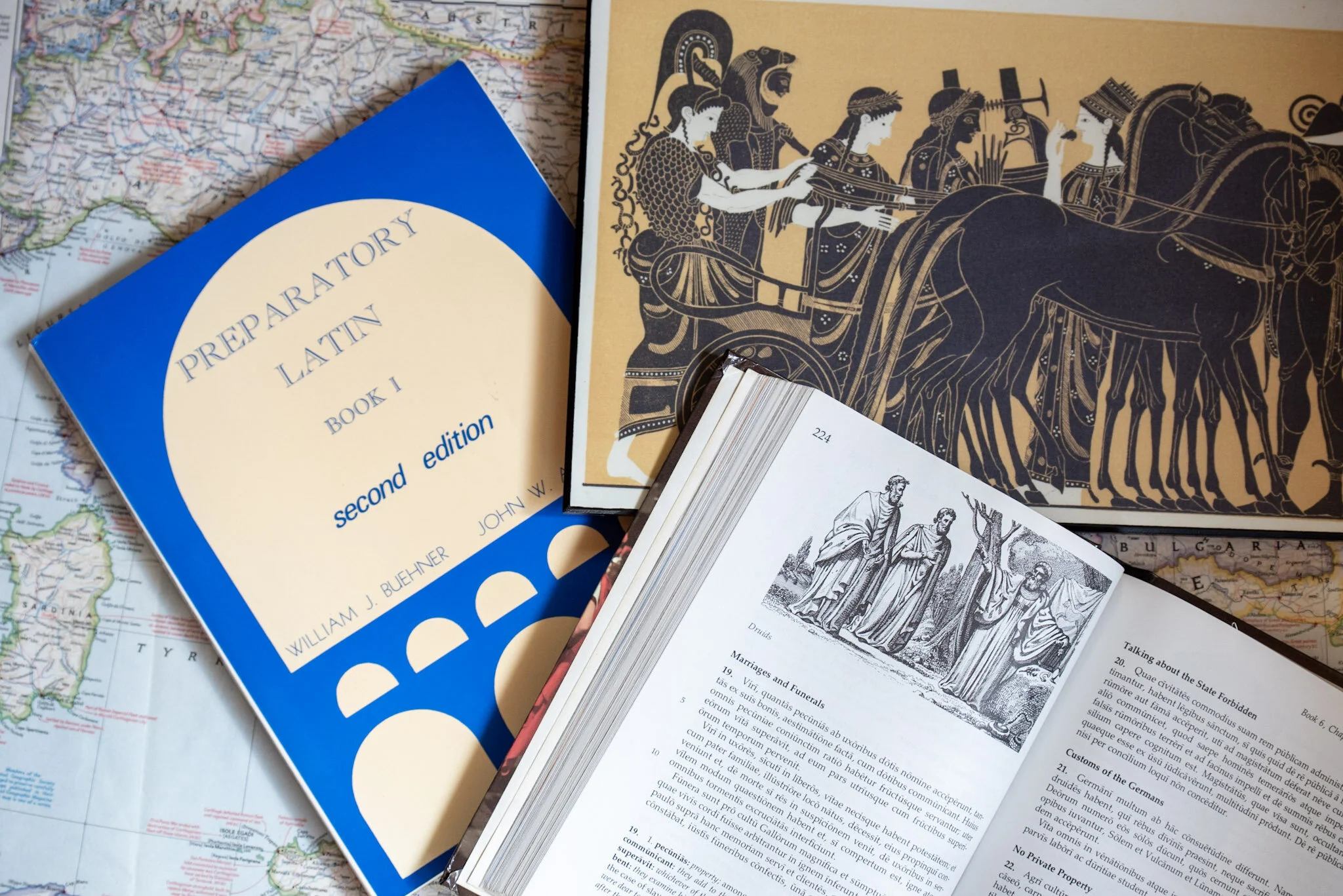
Rigorous study of one modern language (French) and one ancient (Latin) is a staple of the Main Line Classical Academy curriculum.
In addition, we offer optional immersive modern Hebrew language instruction during the school day.
Each of the languages is introduced not merely as a means of communication but as a key to the aesthetics, beliefs, customs, and ways of thinking of a different world. Connecting intimately with studies in literature, poetry, history, and theatre, our language program ensures that students graduate having journeyed far and wide across the three thousand years that separate us from the origins of the Western tradition. The study of Latin, beginning in fourth grade, makes them at home in classical antiquity, while the study of French — begun already in kindergarten and continuing alongside Latin from fourth grade on — opens doors not only to present-day Europe but also to a literature descended directly from that antiquity.
Studying the two languages together gives students insight into the historical undercurrents running beneath Western texts and speech: they discern how Latin shaped, and continues to shape, the Romance languages and English, even as French speakers, working with the inheritance of Latin, came to think, argue, and write in ways genuinely their own. This is, at bottom, the aim of language study itself: to train a kind of attention that cannot be gotten any other way — the capacity to enter a different way of thinking, take it seriously on its own terms, and recognize, when it is genuinely different from your own, that the difference is not an error to be corrected but a way of being human that is worth understanding in its own right.
FRENCH
All MLCA students begin French in kindergarten. In the earliest grades, instruction favors near-immersion, using the Symtalk visual method to build listening and speaking through songs, nursery rhymes, and simple sentence patterns. Over first through third grade, students move into writing and spelling, memorizing fables and poems as their sentences and grammar grow more complex. In fourth grade, French study is joined by Latin, and while the two languages follow separate tracks — French through works such as Le Mystère de St Péray, Vingt Mille Lieues sous les Mers, and Cyrano de Bergerac, Latin through Wheelock's Latin toward Caesar — they are studied in tandem for a reason: French descends from Latin, and pursuing both at once lets students see, in concrete terms, how a living language grows out of an ancient one and yet becomes something genuinely its own.
Our French curriculum builds toward DELF (Diplôme d'Études en Langue Française), the official French government certification of language proficiency, which is organized into four levels of increasing difficulty: A1, A2, B1, and B2. By eighth grade, students have progressed through all four levels. Preparation for the DELF B1 and B2 exams themselves is offered as an Upper School elective; however, the underlying language content required for both levels is taught to every student as part of the core curriculum, whether or not a student ultimately sits for the certification.
LATIN
All MLCA students begin Latin in fourth grade. Our Latin curriculum aims to impart to students a good knowledge of Latin grammar, syntax, and vocabulary, as well as an understanding of the unique aesthetics and worldview inherent to the Latin language. Students gain appreciation of how the ancient Roman worldview, so different from our modern one, is ingrained in the Latin language. Roman notions of time, space, gender, probability, and even color, for example, are fundamentally different from ours. Ultimately, the MLCA Latin program is founded on the belief that a language, when mastered properly — that is, with thorough knowledge of grammar — is the best kind of time machine, transporting the student to a culture far removed in space and time. With this goal in mind, we eschew the common tendency to stretch out the study of grammar indefinitely and to linger over textbook readings for many years. Instead, we use textbooks that present grammatical material in an orderly, concentrated fashion, with little if any distraction, so that by eighth grade students are ready to move beyond the textbook itself and encounter a Roman author directly, beginning with selections from Caesar's Commentarii de Bello Gallico.