
Our Mission
Main Line Classical Academy is a co-educational, purposefully low-tech, K-8 school in Bryn Mawr, PA. We are built on a commitment to a classical liberal arts curriculum, including a rigorous grounding in mathematical and scientific thought. Our approach is driven by the conviction that a mature adult, free both spiritually and intellectually, is the product of thorough, systematic study of the finest achievements in literature, mathematics, sciences, languages, history, and the visual and performing arts.
We are small by design in order to provide the warm atmosphere and close personal attention that best foster learning and the development of character. Our curriculum and our teaching methods guide the student along a journey both joyful and rigorous.
Our Approach to Learning
Uniting Academic Rigor with Joyful Creativity
We believe that what students learn matters and is not merely incidental to the acquisition of a set of skills. Through their own expertise and passion, our teachers inspire our students to seek what is beautiful in all its dimensions. We undertake this wonderful endeavor in light-filled classrooms on a bucolic, three-acre campus that foster the warm, personal community most conducive to learning.
At Main Line Classical Academy, we believe that children are never too young to learn great things. From kindergarten onward, our students explore the finest of literature and poetry in English, French, and, starting in fourth grade, in Latin; come to appreciate the depth and beauty of mathematics; and experience encounters with great historical heroes, scientific discoveries, religious disputes, and military enterprises. In the arts, our students acquire proficiency playing piano and/or violin; gain a solid understanding of musical theory; are introduced to the history of Western art and music; and acquire mastery of the fundamentals of drawing and painting.
MLCA divides itself into a Lower School (grades K-5) and an Upper School (grades 6-8). The academic year, for all grades K through 8, is divided into three trimesters: September through December, January through March, and April through June. Our Lower School curricular model follows a block scheduling format common in middle and high schools, and our Upper School division incorporates into the block schedule a seminar-style format that is often used in high schools and colleges. Beginning in 6th grade, students shift to hour-long instructional periods, with a heavy load of reading required outside the classroom, including in the original French and Latin. By graduation, students will have mastered large swaths of the classical canon, emerging as well-rounded young scholars possessing the knowledge and dispositions to succeed not only in the next stage of their formal education, but also in the next stages of life. In this way, our students embark upon a voyage of the intellect across epochs and continents.
We cover so much ground because we know that our students are capable of it. We guide them on a journey both joyful and rigorous, in which intellectual rigor and academic thoroughness go hand-in-hand with creativity and the joy of learning. The first years of school coincide with a period in children’s lives when their minds are the most supple and receptive to learning: the younger the children, the more easily, happily, and lastingly does their memory master and retain poetry and prose, rules and theorems; the more eagerly and sensitively do they respond to encounters with inspiring historical and literary heroes; and the more fruitfully do they form intelligent, wholesome thoughts and impressions. Our methods of teaching and learning are geared towards ensuring that everything the children encounter in their studies remains fresh and vivid in their hearts and minds for years to come as they mature into intelligent, compassionate leaders in all branches of modern society. Immersed in the classical canon and appreciative of where, how, and why this canon originated, our students are empowered to step into the future not to adapt to its anticipated demands but to shape and determine its course.
Our Teaching Model
Our curriculum is conceived as a series of interconnected adventures in space and time which open the student’s eyes to the artistic, linguistic, mathematical, political, geographical, and scientific roots of the twenty-first century world. This curricular principle underlies our unique teaching model: in our academic program even on the elementary school level, every academic subject is taught by a specialist, with up to eight different specialist teachers interacting with the class in the course of a day. The various subjects are thus led by teachers accomplished in their respective fields and possessing the presence and zeal to inspire their charges.
At the same time, our Principal and Grade Mentors are present throughout the day to provide the children with consistent, nurturing presence. Grade mentors play an important role in identifying and working with students who may need support in organization and study habits, as well as in helping children develop vital social skills by focusing on such concepts as teamwork, good sportsmanship, and classroom behavior. The Good Life course in the Lower School also explores these topics through readings and seminar discussions.
Our curriculum centers on six core academic subjects: English, History, French, Latin, Math, and Science. Alongside these core courses, our unique elective program enables students to pursue a range of rigorous additional academic interests such as programming, art studio, art history, French and Shakespeare performance, prestigious international math and science competitions, debate, classical readings, and Hebrew language.
One of the defining features of a Main Line Classical Academy education is our commitment to intentional technology use. We believe that childhood is best spent reading, exploring, creating, discussing, and engaging with the world firsthand. While technology has an important place in education, we believe that it should be introduced thoughtfully and purposefully, rather than becoming the primary medium through which children learn.
Research continues to show that excessive exposure to smartphones, social media, and digital entertainment can have lasting effects on children's attention, well-being, and development. At MLCA, we seek to preserve the irreplaceable experiences of childhood by creating an environment where students are free to focus, imagine, and build meaningful relationships with their teachers and classmates.
In the Classroom
Intentional technology use does not mean avoiding technology. Our students receive a rigorous education in mathematics, science, programming, engineering, and robotics, with technology incorporated when it genuinely enhances learning.
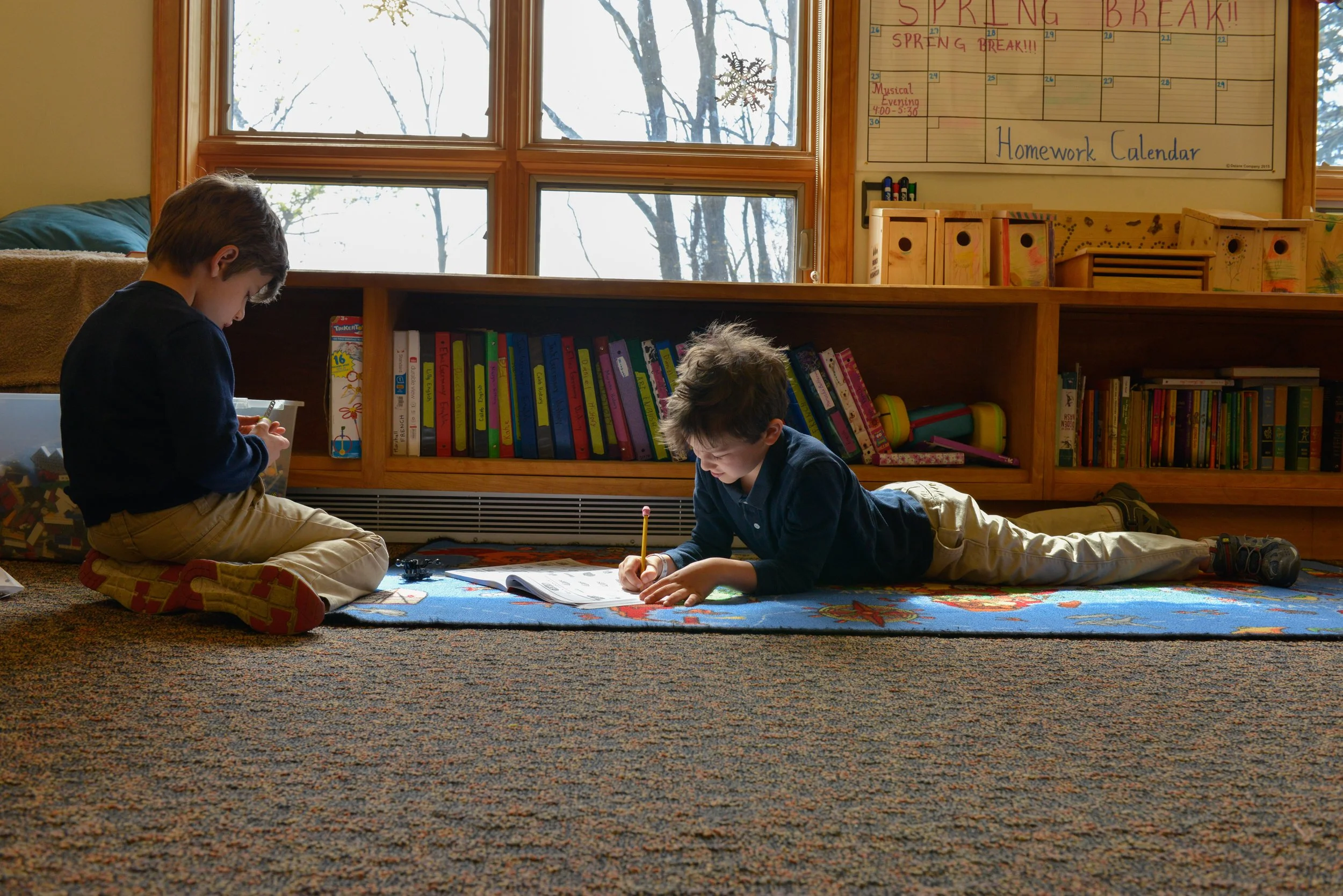
At the same time, we believe that many of the most important educational experiences happen away from a screen. Students write by hand, solve problems collaboratively, participate in rich classroom discussions, and engage in hands-on learning. Rather than watching a video about maple syrup production, our youngest students tap maple trees and make syrup themselves. Rather than relying on digital worksheets, students work with books, paper, and concrete materials that strengthen attention, memory, and understanding.
Technology is treated as a valuable tool, not a substitute for thoughtful teaching or authentic human interaction.
Our Technology Commitment
Families who join Main Line Classical Academy partner with us in preserving a childhood centered on learning, relationships, and discovery. As part of enrollment, parents sign our Parent Commitment, agreeing to delay smartphone ownership and to support intentional, age-appropriate technology use at home. This shared commitment allows our students to grow up in a community where meaningful conversation, outdoor play, deep reading, and genuine friendship remain at the heart of childhood. Many families tell us this sense of community becomes one of the most distinctive and appreciated aspects of an MLCA education.
Our Mission and Logo
MLCA's logo is a compass, and a compass is not a decoration: it is an instrument for locating oneself. That is deliberate. The logo is the clearest statement the school has of what it believes education is for: not the transmission of a fixed body of content, but the formation of people who can find their bearings within a large inheritance and move through it with purpose.
The compass has four points. North is Jerusalem, south is Athens. These name two fundamental and not easily reconciled claims about how human beings come to know what matters. Jerusalem represents the conviction that truth is given, not constructed: that there is a word spoken to humanity that precedes and exceeds what reason alone can reach, and that the appropriate response is fidelity rather than argument. Athens represents the conviction that truth must be sought, tested, and argued toward: that human reason, rightly disciplined, is capable of genuine understanding, and that the life of inquiry is itself a form of excellence. These are not simply religion and secularism. They are two modes of access to truth, and the history of the civilization students inherit is substantially the history of their interaction.
East and west are the Old World and the New World, and they place the first pair in a specific, lived location rather than an abstract one. MLCA's students are growing up in the New World, but the language they speak, the laws they live under, and the ideas they inherit come from an Old World tradition that they did not choose and cannot opt out of. The compass does not ask a student to pick a side, in either direction. It asks her to know where she stands: within a civilization shaped by the long encounter between revelation and reason, and within a particular American present shaped by a European past.
Around the compass runs the school's name, and beneath it, curving the other way, a Latin inscription: Iter Deo Et Musis Sacrum — "a journey sacred to God and to the Muses." The phrase is an adaptation of the 1669 inscription on the walls of the Tübingen Stift, a school whose alumni include Kepler, Hegel, and Hölderlin — a scientist, a philosopher, and a poet, each of whom pursued a different discipline as a form of devotion. The inscription does not resolve the tension between Jerusalem and Athens, and the logo does not ask it to. It names both as sacred — worth a lifetime's devotion — and holds them open together rather than collapsing one into the other. That, in the school's understanding, is precisely what an education is: not a settled answer, but a journey undertaken in earnest, in the company of both cities, toward a fuller possession of what is true, good, and beautiful.